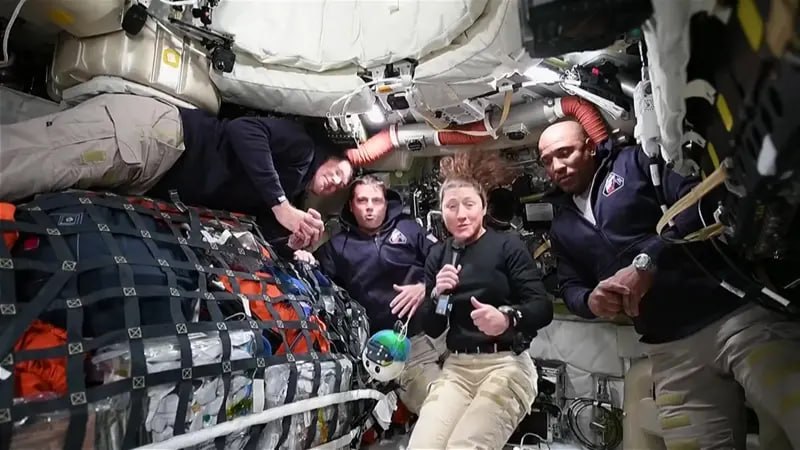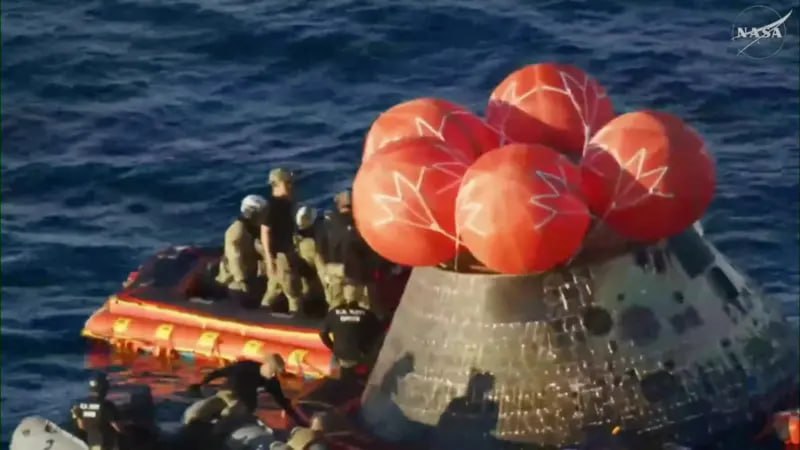
After a monumental 10-day journey that captured the imagination of the world, the Artemis II mission has come to a triumphant end. The Orion spacecraft, carrying a crew of four pioneering astronauts, successfully splashed down in the Pacific Ocean last night. This event marks a massive milestone in human spaceflight, officially closing the chapter on humanity's first return to the lunar vicinity in more than half a century and laying the critical groundwork for long-term deep-space exploration.
A Historic Crew and a Record-Breaking Flight
The Artemis II mission was not just a technological triumph; it was a profound human achievement. The four astronauts aboard the Orion capsule—Commander Reid Wiseman, Pilot Victor Glover, and Mission Specialists Christina Koch and Jeremy Hansen—represented the diverse future of space exploration. The crew included the first woman, the first person of color, and the first international partner (Canadian) to fly beyond low Earth orbit.
During their 10-day voyage, the crew pushed the boundaries of human endurance and aerospace engineering. After launching atop the massive Space Launch System (SLS) rocket, the Orion capsule entered a "free-return trajectory." This path utilized the Moon's gravity to sling the spacecraft back toward Earth without requiring major propulsive maneuvers for the return trip. In doing so, the crew traveled more than 400,000 kilometers (nearly 250,000 miles) from Earth—shattering previous records to become the farthest any human being has ever traveled into the deep cosmos.
Testing the Limits: Life Support and Navigation
Unlike the uncrewed Artemis I mission, Artemis II was a critical test of Orion's life support, communication, and manual navigation systems under actual crewed conditions. Throughout the 10 days, the astronauts performed a series of rigorous evaluations:
- Manual Piloting: Commander Wiseman and Pilot Glover took manual control of the Orion capsule to test its handling characteristics in the vacuum of space, ensuring the crew could safely pilot the ship in the event of an automated system failure.
- Life Support Diagnostics: The crew continuously monitored carbon dioxide scrubbing, temperature control, and radiation shielding, ensuring the internal environment remained safe during the transit through the hazardous Van Allen radiation belts.
- Deep Space Communications: The mission successfully tested high-bandwidth communication relays via NASA's Deep Space Network, allowing the crew to transmit high-definition video and data back to mission control in Houston.
A Fiery and Unforgiving Re-entry
The final and most perilous phase of the mission was the return to Earth. As the Orion capsule approached the planet, it was traveling at a staggering speed of nearly 40,000 kilometers per hour (Mach 32). Plunging into the thick layers of Earth's atmosphere, the friction generated intense plasma, subjecting the spacecraft's exterior to searing temperatures reaching 2,760 degrees Celsius (5,000 degrees Fahrenheit)—about half as hot as the surface of the Sun.
To survive this inferno, Orion utilized an innovative "skip re-entry" maneuver. The spacecraft dipped into the upper atmosphere to bleed off speed, lifted back out briefly to cool down, and then made its final descent. During the peak heating phase, the crew experienced an expected radio communications blackout lasting several agonizing minutes. However, Orion's state-of-the-art ablative heat shield performed flawlessly, protecting the astronauts inside before a sequence of parachutes successfully deployed to slow the capsule for a gentle splashdown.
Swift Recovery and Post-Flight Health
Immediately following the splashdown, a massive, highly coordinated recovery operation commenced. Joint rescue teams from the U.S. Navy and NASA, utilizing helicopters, rigid-hull inflatable boats, and a massive amphibious transport dock ship, secured the floating capsule in the Pacific waters.
The four astronauts were safely extracted and brought aboard the recovery vessel. Initial medical evaluations confirmed that despite the physical toll of zero gravity and the high G-forces of re-entry, all four crew members are in excellent health and high spirits. They are currently undergoing standard post-flight conditioning and are eagerly awaiting their return to Houston, Texas, to reunite with their families and debrief engineers on their historic flight.
Setting the Stage for Artemis III and Mars
The resounding success of the Artemis II mission signals the dawn of a permanent human presence in deep space. By validating the SLS rocket, the Orion spacecraft, and the crewed systems necessary to survive in deep space, NASA has officially cleared the path for the highly anticipated Artemis III mission, slated for 2028.
Artemis III will take the next monumental step by landing the first humans on the lunar South Pole—a region rich in water-ice that could eventually be used to produce drinking water, breathable oxygen, and rocket fuel. Ultimately, the lessons learned from these lunar expeditions will serve as the crucial blueprint for humanity's most ambitious endeavor yet: sending the first astronauts to the surface of Mars in the coming decades.
Ephrem Ageru
Senior Editor at TrendStorm. Monitoring the pulse of the internet 24/7 to bring you the fastest breaking stories in tech, viral culture, and world news.